Feel the machine.
Responsive handling and physically grounded force feedback. A direct connection from the contact patch to your hands.
DRIVING
A NEW DIMENSION OF DRIVING
A driver’s instinct. An engineer’s insight.
One extraordinary connection.
What if you could feel a car at its limit — and understand exactly what brought it there?
ATLAS is a vehicle dynamics lab built around three equal ambitions: compelling driving, credible physics, and the tools to understand both. A place to chase a better lap, build a better setup, or explore the forces that make a car feel alive.
The reward is more than speed. It’s knowing why.
Responsive handling and physically grounded force feedback. A direct connection from the contact patch to your hands.
DRIVINGReveal the forces beneath the bodywork. Explore grip, weight transfer and the chain of events behind every response.
PHYSICSTurn an observation into an experiment. Change a parameter, compare the evidence, and feel the difference for yourself.
ENGINEERING & LEARNINGTHE SPACE ATLAS IS BUILT FOR
The immersion that draws you in. The visibility that keeps you learning. ATLAS is being designed to connect the driver’s seat and the engineering lab in one accessible experience.
Instinct. Immersion. Pace.
Evidence. Experiment. Insight.

02 / THE EXPERIENCE
The wheel goes light. The rear begins to rotate.
That moment is where the lab begins.
ONE CONTINUOUS DISCOVERY
Drive first. Go deeper when curiosity takes over. The planned ATLAS experience brings feeling, evidence and experimentation into a single loop.
Find the balance. Sense the grip. Drive the car.
Reveal tyre forces, chassis motion and steering torque.
Connect what you felt to the physics behind it.
Make an informed adjustment. Test a clear hypothesis.
Return to the track. Compare. Refine. Repeat.
A connected set of tools designed to turn vehicle behaviour into something you can see, question and improve.
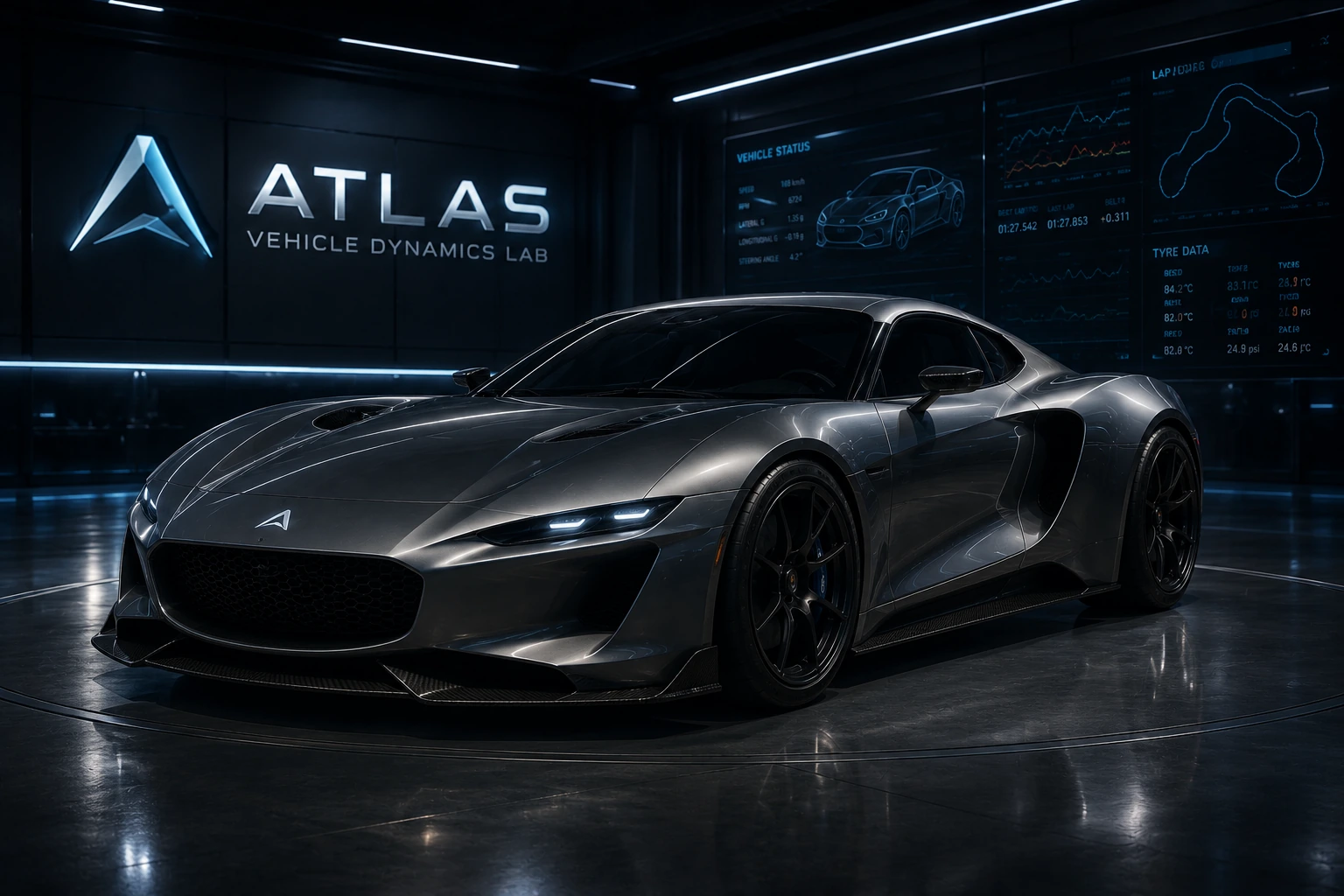 ATLAS PROTOTYPE / ORIGINAL VISUAL CONCEPT
PHYSICS VISION
Switch from pure driving to a view of the forces shaping it. See tyre loads, slip, suspension movement and steering contributions in context.
“Why did the steering go light?”
HERMES / TELEMETRY
Revisit a corner with synchronised telemetry and Engineering Replay. Compare two runs and connect a setup change to what actually happened.
“Did that change make the car better?”
ATHENA / AI ENGINEER
An AI engineer and coach designed to work from telemetry, driver inputs and vehicle setup. Explain observations, surface uncertainty, and suggest the next useful experiment.
“What should I investigate next?”
DAEDALUS / VEHICLE DESIGN
A vehicle and setup workspace where geometry, mass, tyres and powertrain become connected design decisions. Every adjustment should carry an engineering interpretation.
“What happens if I change this?”
ARGUS / VALIDATION
A validation framework designed to compare model behaviour against reference curves and repeatable tests. Record assumptions, parameter sources and known simplifications.
“How do we know the model is credible?”
These tools describe the intended product. The imagery is concept art.
04 / THE ENGINEERING DEPTH
ATLAS starts at the contact patch and follows the connection through the whole vehicle. The goal: a coherent physical model whose behaviour can be inspected and explained.
Build cars.
Understand physics.
Feel every force.
Explore the relationship between load, slip and grip — including what changes when braking and cornering happen together.
Understand how the platform moves, where the load goes, and why a setup change alters the car’s balance.
Build the steering system, then send its torque to the wheel. Trace the feedback from the tyres through the rack and column.
Follow torque from the engine to the road and see how power delivery changes the balance on entry, through a shift and on corner exit.
Explore the interactions that make a car a system: speed, ride height, braking, alignment and mass distribution.
The C++ Atlas core is designed to stay independent of the presentation engine. A fixed simulation step and explicit vehicle state provide a foundation for driving, analysis and research.
05 / FIND YOUR WAY IN
Built for people who love the feeling of driving — and those who can’t stop asking how it works.
Connect your inputs to the car’s response. Learn the limit, understand the balance, and develop repeatable skill.
DRIVER DEVELOPMENTUse controlled experiments, setup comparisons and replay to investigate how the vehicle behaves.
ENGINEERING EXPLORATIONTurn vehicle dynamics into something you can experience. Learn through guided experiments, challenges and the ATLAS Academy.
INTERACTIVE LEARNINGInvestigate vehicle concepts, build configurations and develop models on an inspectable physics foundation.
VEHICLE & MODEL CREATIONATLAS is in active development. The path starts with a driving prototype and grows towards a complete driver–engineer experience.
The Python physics prototype has been ported to C++, with Godot providing the current driving and graphics environment.
PROTOTYPE IN DEVELOPMENTCurrent focus: handling, integration and validation.
Physics Vision, force-feedback analysis, Hermes telemetry, Engineering Replay and Compare Runs bring the vehicle’s behaviour into view.
PLANNEDAthena, the Academy, Physics Explorer, setup challenges and controlled experiments help drivers and engineers progress.
PLANNEDVehicle design, broader car and track libraries, an engineer role with an AI driver, and longer-term career, race-weekend and multiplayer possibilities.
LONGER-TERM VISIONA range of driving experiences. From lightweight road cars and karts to single-seaters, GT cars and the ATLAS Prototype. Final vehicles and content will depend on development and licensing.
Progress through understanding. Start with a clean driving view. Reveal deeper tools as your questions grow. A better grasp of the car becomes part of the progression.
ENGINEER. ANALYSE. MASTER.